Top AI Skills Every Biotech Student Should Learn in 2026
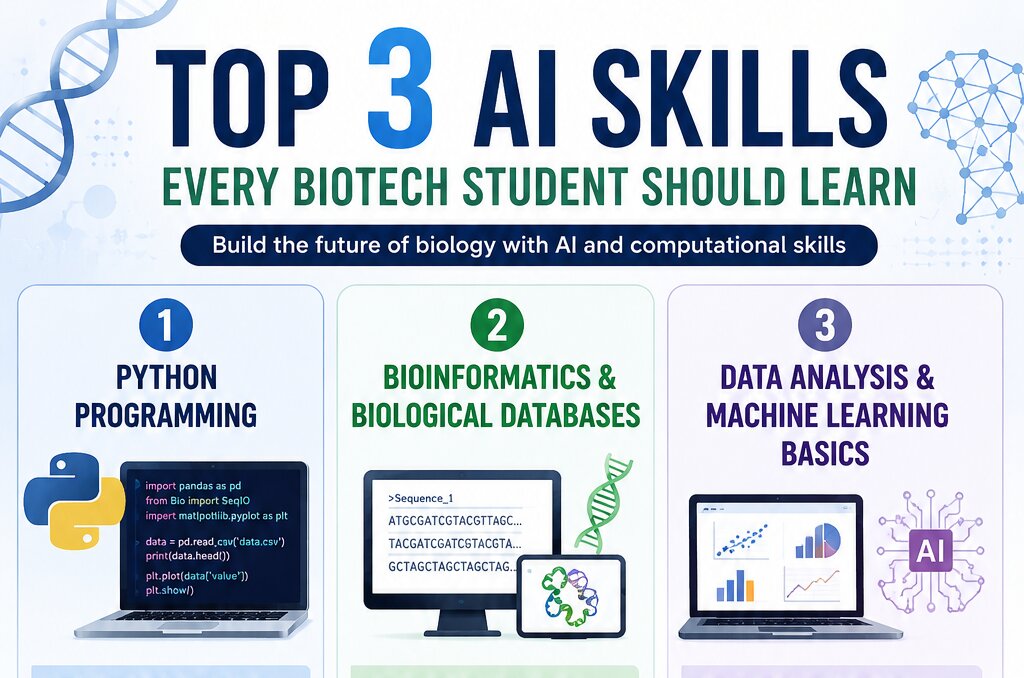
Artificial Intelligence (AI) is rapidly transforming biotechnology, healthcare, and life sciences. From drug discovery to genome analysis, companies and research institutes are now looking for students who can combine biological knowledge with computational skills. For biotechnology students, learning AI does not mean becoming a software engineer. It means understanding how to use computational tools to solve biological problems. Here are the most important AI-related skills every life science student should start learning — along with useful resources to begin.
1) Python Programming
Python is the most widely used programming language in bioinformatics and AI because it is beginner-friendly and highly useful for biological data analysis.
Students should learn:
-Basic programming concepts such as variables, loops, functions, and conditions
-Reading and processing biological data files like FASTA and CSV
-Data analysis using libraries such as Pandas and NumPy
-Plotting graphs and visualizing biological datasets using Matplotlib
-Writing simple scripts for sequence analysis and automation
Learning Python helps students handle large biological datasets and prepares them for advanced bioinformatics and machine learning applications.
Best Resources:
-Python for Everybody
-freeCodeCamp Python Course
-Kaggle Learn Python
2) Bioinformatics Basics
Bioinformatics forms the foundation of computational biology and is essential for students interested in genomics, molecular biology, and AI-based biological research.
Students should learn:
-How DNA, RNA, and protein sequences are analyzed computationally
-Sequence alignment techniques using BLAST and Clustal Omega
-Searching and extracting information from databases like NCBI, UniProt, and PDB
-Basics of genome annotation and phylogenetic analysis
-Protein structure visualization and interpretation
These skills are widely used in research projects, higher studies, and biotech industries.
Best Resources:
NCBI Tutorials
EMBL-EBI Training
Coursera Bioinformatics Specialization
3)Data Analysis & Visualization
Modern biology generates enormous amounts of data through sequencing technologies, clinical studies, and omics research. Students who can analyze and interpret this data have a strong advantage.
Students should learn:
-Cleaning and organizing biological datasets
-Understanding basic statistics used in biological research
-Creating graphs, heatmaps, and charts for scientific interpretation
-Identifying patterns and trends in experimental data
-Presenting data clearly in reports and presentations
Data visualization is especially important because research findings must be communicated effectively.
Useful tools:
(i) Excel (ii) R (iii) Python (iv) Tableau
Best Resources:
-Kaggle Data Visualization
-Google Data Analytics Course
Final Thoughts:
The future of biotechnology is becoming increasingly computational and AI-driven. Students who begin learning these three skills early will be better prepared for careers in:
(I) Bioinformatics
(II) Drug discovery
(III) Precision medicine
(IV) Healthcare AI
(V) Genomics research
(VI) Biotech startups
The best approach is to start small, practice consistently, and gradually build interdisciplinary skills.
Topics
- #ArtificialIntelligence
- #Bioinformatics
- #MachineLearning
- #PythonProgramming
- #LifeSciences
- #BiotechCareers
- #ComputationalBiology
- #AIinHealthcare
- #BioDisha
Discussion
Reading this article needs no account. Liking it or joining the discussion does.