
GPT-Rosalind Explained: A Game-Changer for Life Sciences Students and Researchers
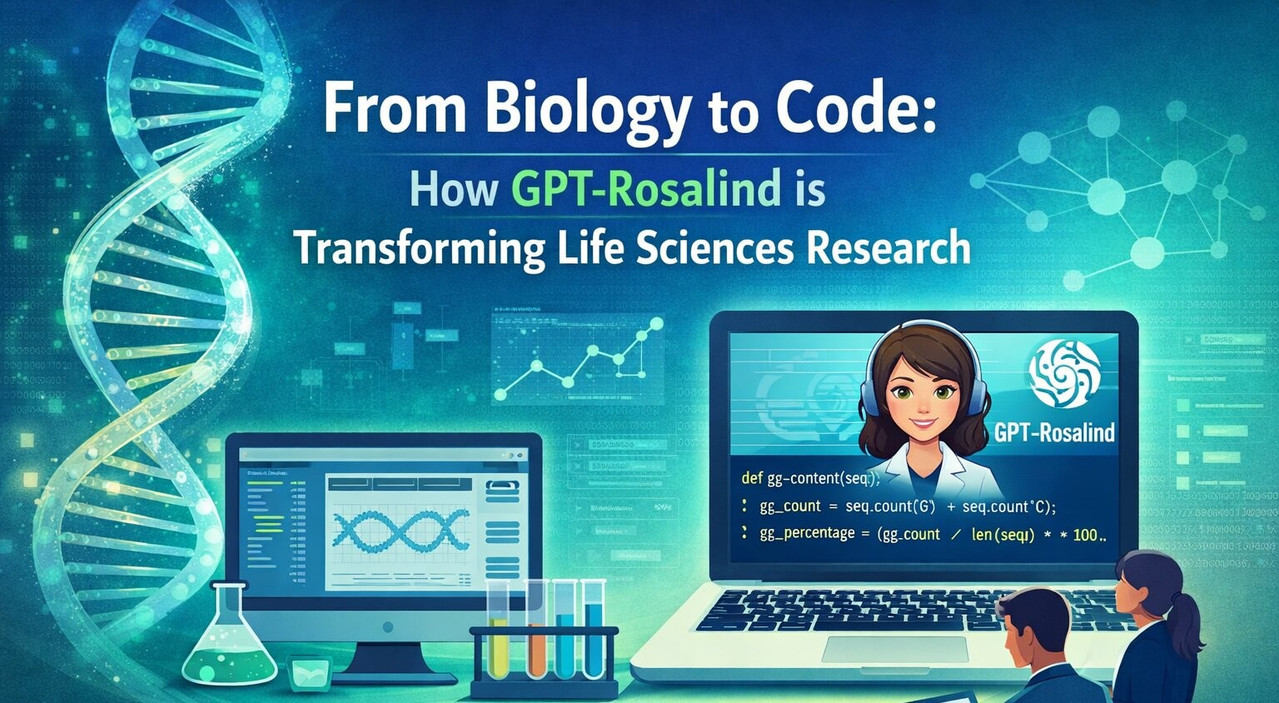
The landscape of life sciences research is rapidly evolving. Today, it is no longer enough to understand biology—you are expected to analyze data, write code, and interpret complex datasets. For many students, this transition from theory to computational research feels overwhelming. This is where GPT-Rosalind is beginning to play a powerful role. It is not just another AI tool—it represents a shift in how life sciences students learn bioinformatics, approach research problems, and build computational confidence.
What is GPT-Rosalind?
GPT-Rosalind is an AI-assisted learning approach that combines problem-solving frameworks from Rosalind with the reasoning capabilities of modern AI tools like ChatGPT.
It helps students:
(i) Solve bioinformatics problems step-by-step.
(ii) Understand the logic behind computational biology
(iii) Generate and refine code for biological data analysis
In simple terms, it acts as a bridge between biology and computation.
Why Life Sciences Research Now Demands Computational Skills?
Modern research areas such as: Genomics, Transcriptomics, Drug discovery, Systems biology all rely heavily on computational analysis.
For example, analyzing sequencing data or identifying mutations requires not just biological knowledge, but also familiarity with: Algorithms, Programming (Python/R), Data interpretation
This shift has created a gap—especially for students from traditional biology backgrounds.
Where Students Struggle in Research.
From a student’s perspective, the challenges are very real:
(i) Translating Biology into Code
You understand DNA sequences, but how do you write a script to analyze them?
(ii) Lack of Mentorship in Computational Work
Not every lab provides hands-on coding guidance.
(iii) Fear of Making Mistakes
Students hesitate to try because coding errors feel intimidating.
(iv) Slow Learning Curve
Without guidance, learning bioinformatics can take months of trial and error.
How GPT-Rosalind Supports Life Sciences Research
(i) Problem-Solving Like a Researcher:
GPT-Rosalind doesn’t just give answers—it explains:
-What the problem is asking
-Which biological concept is involved
-How to approach it logically
This mirrors how real research problems are tackled.
(ii) Code Assistance for Data Analysis:
Whether you are:
Working on sequence alignment, Calculating GC content, Analyzing mutations
GPT-Rosalind can:
Generate code, Explain each step, Help debug errors
This is especially valuable during:
Dissertation projects, Internships, Early-stage research work
(iii) Strengthening Conceptual Understanding
Research is not about memorization—it’s about clarity.
GPT-Rosalind helps simplify complex topics like:
Sequence alignment algorithms, Phylogenetics, Genome assembly, making them easier to understand and apply.
(iv) Accelerating Learning and Productivity:
Instead of spending hours stuck on one problem, students can:
Learn faster, Experiment more and focus on interpretation rather than just execution.
Real Research Applications
GPT-Rosalind can be useful in:
Academic Projects, Supporting M.Sc. dissertations, Assisting in computational biology assignments
Research Internships, Helping you understand datasets, Writing basic analysis scripts
Early PhD Preparation, Building computational thinking, Practicing real-world problem-solving
But Is It Enough for Research?
Not entirely—and this is important to understand.
GPT-Rosalind is a support tool, not a replacement for scientific thinking.
Limitations:
(i) AI-generated code may not always be accurate
(ii) Complex research problems still require expert validation
(iii) Over-dependence can reduce independent thinking
(iv) The key is to use it wisely.
Best Practices for Students to truly benefit from GPT-Rosalind:
-Attempt problems before asking for help
-Use it to understand why, not just how
-Cross-check outputs with trusted sources
-Practice regularly on platforms like Rosalind
Think of it as a mentor—not a shortcut.
Why This Matters for Your Career
Students who combine biology with computational skills have a clear advantage in:
-Research internships
-PhD admissions
-Industry roles in biotech and pharma
Learning to use tools like GPT-Rosalind early can help you:
-Build confidence in coding
-Approach research problems independently
-Stand out in a competitive field
The Future: AI-Assisted Research Learning
We are entering an era where AI will:
Personalize learning, Assist in data analysis, Support hypothesis generation
Tools like GPT-Rosalind are just the beginning, for life sciences students, this means one thing:
Those who adapt early will lead tomorrow’s research.
Final Thoughts
Bioinformatics and computational biology are no longer optional—they are essential.
GPT-Rosalind simplifies the learning curve, making research more accessible for students who once felt intimidated by coding.
But remember:
*Technology can guide you, but curiosity and critical thinking will define you as a researcher.*
Topics
- GPT Rosalind in research
- Bioinformatics tools for students
- AI in life sciences research
- Computational biology learning
- Rosalind bioinformatics practice
- AI tools for biotechnology students
- Learn bioinformatics for research
Discussion
Reading this article needs no account. Liking it or joining the discussion does.