Research Trends Shaping Biotechnology Careers (2026 & Beyond)
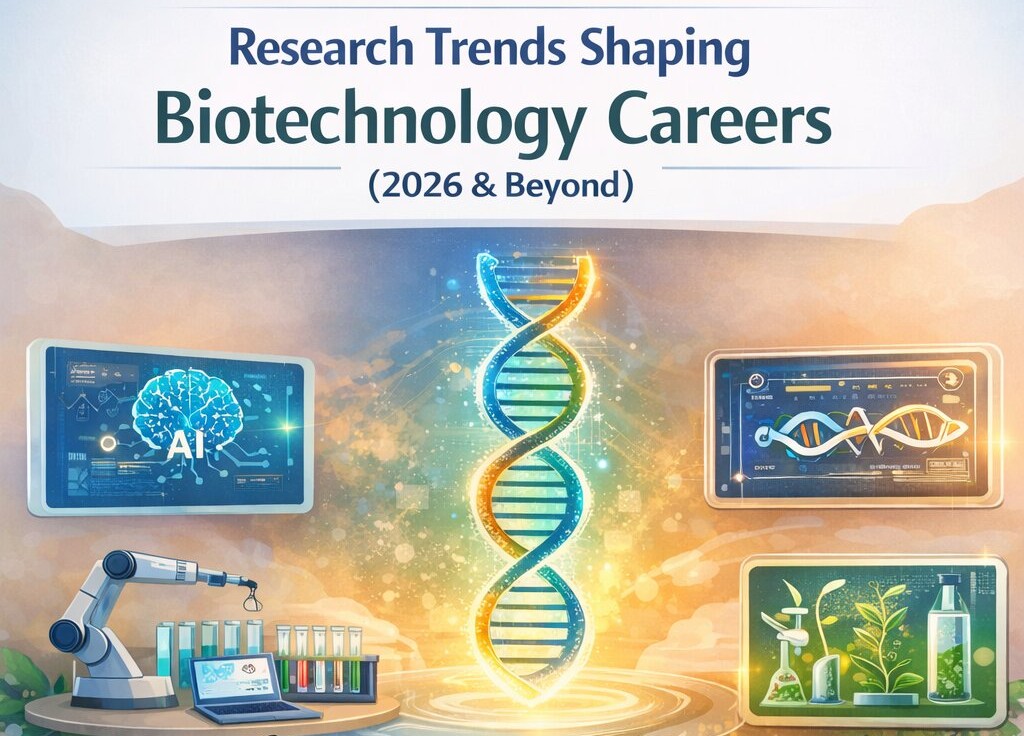
Biotechnology is no longer limited to laboratory research—it is now a powerful intersection of biology, data science, engineering, and innovation. As the field evolves rapidly, career opportunities are being reshaped by cutting-edge research trends. For students and early-career professionals, understanding these trends is not optional—it’s essential for staying relevant. In this blog, we decode the major research trends shaping biotechnology careers, the skills they demand, and how you can align your career with the future.
(1) AI-Driven Biotechnology: The Rise of Bioinformatics & Computational Biology
One of the biggest transformations in biotech is the integration of Artificial Intelligence (AI) and machine learning into biological research.
AI is now being used to:
(i) Predict protein structures
(ii)Accelerate drug discovery
(iii) Analyze genomic data at scale
This has created massive demand for:
(i) Bioinformatics scientists
(ii) Computational biologists
AI-biotech specialists
In fact, AI-powered drug discovery is one of the fastest-growing domains in biotech today.
Career Insight
If you combine biology + coding (Python/R), you become extremely valuable in the job market.
(2) CRISPR & Gene Editing: Precision Medicine Revolution.
Gene editing technologies like CRISPR are revolutionizing healthcare by enabling:
Correction of genetic disorders
Development of personalized therapies
Advanced crop engineering
CRISPR is transitioning from research labs to clinical applications and therapies, making it a high-impact career area.
Emerging Roles
(i) Gene editing specialist
(ii) Molecular geneticist
(iii) Clinical research scientist
Career Insight
Strong fundamentals in molecular biology, genomics, and lab techniques are critical here.
(3) Synthetic Biology: Engineering Life for Sustainability
Synthetic biology combines biology with engineering to design new biological systems.
Applications include:
(i) Biofuels and green chemicals
(ii) Lab-grown meat
(iii) Biodegradable materials
This field is expanding rapidly due to sustainability needs and decreasing DNA synthesis costs.
Career Opportunities
(i) Synthetic biologist
(ii) Metabolic engineer
(iii) Industrial biotech scientist
Career Insight
Interdisciplinary skills (biology + engineering + data science) are highly valued.
(4) Personalized Medicine & Cell/Gene Therapy
Healthcare is shifting from “one-size-fits-all” to personalized treatment based on genetics.
Key advancements:
(i) Cell therapy
(ii) Gene therapy
(iii) RNA-based treatments
These innovations are driving demand for professionals in:
(i) Clinical research
(ii) Translational medicine
(iii) Regulatory affairs
Biotech innovation in personalized medicine is a major growth driver for the industry.
Career Insight
Understanding clinical trials, genomics, and regulatory frameworks is essential.
(5) Biomanufacturing & Industrial Biotechnology
Biotech is transforming industries beyond healthcare:
(i) Sustainable manufacturing
(ii) Enzyme-based production
(iii) Alternative proteins
Biomanufacturing is becoming a major employment generator globally.
Career Roles
(i) Bioprocess engineer
(ii) Quality control (QC) / Quality assurance (QA)
(iii) Production scientist
Career Insight
Hands-on skills in fermentation, downstream processing, and GMP are in demand.
(6) Big Data Biology & Multi-Omics Revolution
The explosion of biological data (genomics, proteomics, metabolomics) has created a new domain:
Data-driven biology
Scientists now work with:
(i) Massive sequencing datasets
(ii) Multi-omics integration
(iii) Predictive biological modeling
Career Roles
(i) Data scientist (life sciences)
(ii) Systems biologist
(iii) Genomics analyst
Career Insight
Data interpretation is becoming as important as lab work.
(7) Green Biotechnology & Climate Solutions
Biotechnology is playing a key role in addressing climate change through:
(i) Carbon capture using microbes
(ii) Bio-based materials
(iii) Sustainable agriculture
This area is gaining attention due to global sustainability goals and policy support.
Career Opportunities
(i) Environmental biotechnologist
(ii) Agricultural biotech scientist
(iii) Sustainability analyst
Key Skills You Must Build (2026 Roadmap)
To stay competitive in biotechnology, focus on building a strong mix of technical, emerging, and soft skills. Core technical expertise should include molecular biology & lab techniques, bioinformatics tools (Python, R), data analysis & statistics, and bioprocessing skills. Alongside this, develop emerging competencies like AI in biology, genomics & sequencing, and regulatory knowledge to align with industry trends. Equally important are soft skills such as scientific communication, interdisciplinary collaboration, and problem-solving, which are essential for working effectively in modern, cross-disciplinary biotech environments.
Challenges You Should Be Aware Of
Biotech is promising—but competitive.
Some realities:
High demand for specialized skills
Entry-level roles can be limited
Rapid technological changes require continuous learning
Topics
- Biotechnology careers
- Biotechnology trends 2026
- Future of biotechnology
- Careers in biotechnology
- Biotechnology research trends
- BioDisha blogs
- Biotechnology career guidance
- Life sciences career roadmap
- Research careers in India
Discussion
Reading this article needs no account. Liking it or joining the discussion does.